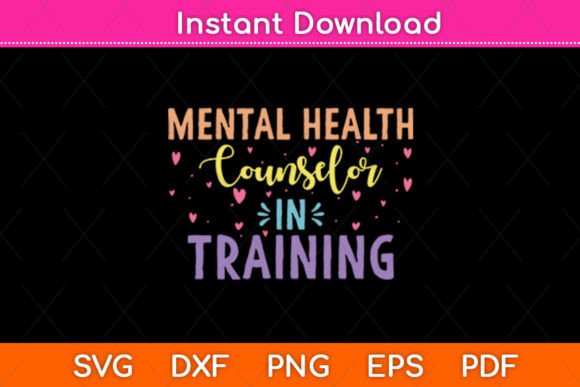
Mental Health Counselor in Training SVG Review
As a designer who bridges the gap between digital graphics and tangible textiles, I approach every new file with a specific question: will this actually stitch well? The Mental Health Counselor in Training SVG is marketed primarily as a print cut file compatible with Cricut and Silhouette machines, but for those of us in the embroidery space, it represents a different kind of opportunity. When evaluating this graphic for use in a machine embroidery design workflow, we have to look beyond the clean vector lines on screen and visualize how those paths will translate into thread tension, fabric stability, and final product durability.
Translating Vector Graphics to Stitched Reality
My first impression of this design is its clean, declarative typography. For a counselor in training, the aesthetic needs to balance professionalism with approachability, and this graphic achieves that through straightforward lettering and balanced spacing. However, as an embroidery file candidate, simplicity can be deceptive. Because this is originally intended for vinyl cutting or sublimation, the lines are likely uniform in width. In embroidery, uniform lines often require conversion to either a running stitch or a satin stitch column.
If you are digitizing this yourself or purchasing a pre-digitized version based on this graphic, pay close attention to the letter height. Text that looks crisp at four inches wide on a monitor can become illegible puckered messes when scaled down for a chest logo. The visual personality here is supportive and educational, making it ideal for custom apparel like sweatshirts or tote bags where the message needs to be readable from a conversational distance. The layout suggests a centered placement, which works beautifully for sweatshirt embroidery but requires careful hooping alignment to avoid looking crooked on a finished garment.
A Real-World Project: The Clinical Placement Tote
To truly test the viability of the Mental Health Counselor in Training SVG, I recently evaluated it for a custom embroidered tote bag project intended for graduate students beginning their clinical placements. These students need gear that feels professional yet personal, something they can carry to supervision meetings or client sites without looking overly casual.
I chose a natural canvas tote because the fabric texture provides excellent stability for text-heavy designs. Canvas is forgiving; unlike stretchy knits, it holds stitch density well without distorting. For this project, I treated the SVG as a template for a fill stitch font rather than a satin stitch. Satin stitches on canvas can sometimes sink into the weave, whereas a textured fill stitch sits on top of the fibers, ensuring the "Counselor in Training" text remains legible even after months of heavy use. The result was a handmade product that felt substantial and high-value. The student recipient noted that the bag felt like a legitimate piece of professional identity, not just a novelty item. This confirms that when adapted correctly, this design carries enough weight to serve as a meaningful personalized gift or boutique inventory item.
Navigating Fabric Challenges and Hoop Limitations
While the design shines on stable fabrics, caution is required when applying it to more challenging materials. As an experienced reviewer, I must emphasize that this graphic’s success depends entirely on your substrate choice. If you are planning baby embroidery or items on thin, stretchy jersey knits, the original line weights of the SVG may be too aggressive. Dense stitching on lightweight fabric leads to bulletproofing—a stiff, uncomfortable patch of thread that ruins the drape of the garment.
For curved surfaces like caps, this design presents specific hurdles. The horizontal span of "Mental Health Counselor" is significant. On a standard cap frame, you risk losing the outer letters to the curve or hitting the visor seam. In these cases, I recommend breaking the design into two lines or arching the text significantly during the digitization phase. Always verify your hoop size before committing to a stitch-out. A design that fits a 5x7 hoop perfectly flat may distort when wrapped around a cylindrical surface.
Dark fabrics also demand strategic thinking. If you are using white thread on a navy scrub top or black hoodie, ensure your thread colors offer sufficient contrast. More importantly, check if the digitized version includes an underlay. Without proper underlay on dark, textured fabrics, the top stitches can separate, revealing the fabric beneath and making the text look messy. For commercial embroidery projects where consistency is key, always run a test sew-out on the exact fabric you intend to sell or gift.
Professional Value and Commercial Considerations
For Etsy sellers and small shop owners, the Mental Health Counselor in Training SVG taps into a passionate niche. Graduate students and new professionals are actively seeking ways to express their developing identity. However, buyer engagement relies on trust. Your listing photos must accurately represent how the design looks stitched, not just how it looks digitally. Use printable mockups responsibly, but always include at least one photo of a real finished product. Customers need to see stitch definition and scale to feel confident in purchasing a digital embroidery file or a physical item.
From a business perspective, versatility is this design's greatest asset. It transitions easily from a tote bag design to an embroidered patch for lab coats. Patches are particularly effective for this demographic, as they allow students to display their status without permanently altering expensive professional clothing. If creating patches, use a merrowed edge or a tight satin border to prevent fraying. Remember that design assets in the mental health niche should always maintain a tone of respect and clarity; avoid overly whimsical fonts or cluttered layouts that might undermine the professional nature of the field.
Essential Designer Notes for Success
Before you load this design into your machine or list it in your shop, adhere to these practical guidelines derived from real-world testing:
- Verify Licensing: Since this is sold as a cut file, confirm explicitly whether the license covers machine embroidery and commercial sale of finished goods. Do not assume cross-format rights.
- Test Stitch Density: If digitizing from scratch, aim for a density that covers the fabric without causing puckering. For canvas, a slightly higher density works; for knits, reduce density and increase stabilizer weight.
- Stabilizer Selection: Match your stabilizer to the fabric, not the design. Cut-away stabilizer is non-negotiable for stretchy apparel to maintain the integrity of the text over time.
- Scale Responsibly: Never shrink text below the minimum recommended height for your chosen stitch type. If the design becomes too small to read clearly, it is better to omit it than to produce a subpar embroidery project.
- Contrast Check: View your thread color choices in grayscale before stitching. If you cannot read the text in black and white, the contrast is insufficient for quick recognition.
- Mockup Accuracy: When selling to other makers, provide accurate size charts and suggested fabric types. Helping your customers succeed reduces returns and builds long-term loyalty for your craft business.
The Mental Health Counselor in Training SVG is more than just a trendy phrase; it is a functional design element that, when executed with technical precision, serves a genuine community need. Whether you are creating a holiday gift for a stressed grad student or building a product line for your handmade shop, success lies in respecting the relationship between the digital art and the physical stitch. Take the time to test, adjust, and refine. Your dedication to quality is what transforms a simple graphic into a cherished, professional-grade textile.